Camera Rotation
Colonial Extractions
California Museum of Photography
July 26, 2025 to March 29, 2026
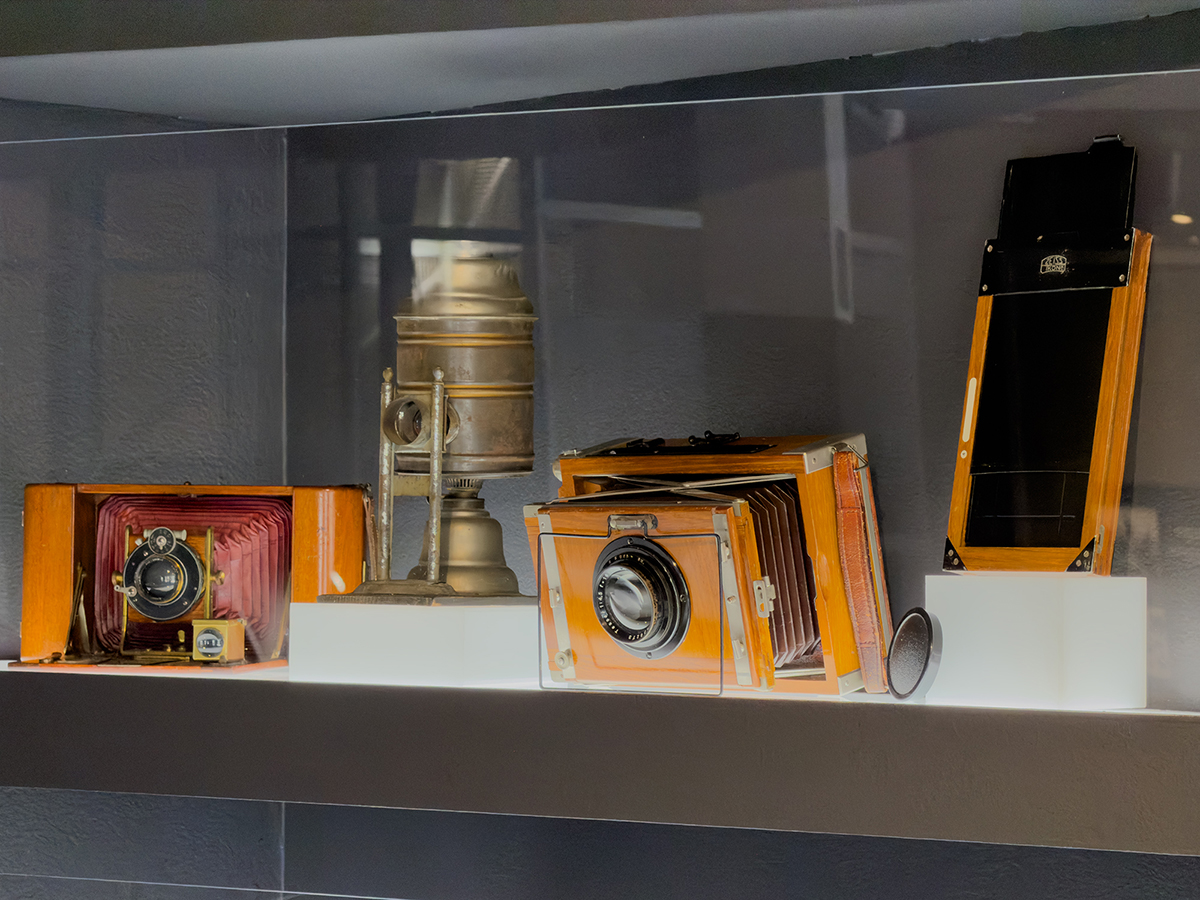
Camera Rotation: Colonial Extractions is part of the California Museum of Photography’s rotating lobby display, featuring objects drawn from its extensive Technology Collection. Organized in conjunction with the exhibition Fariba Hajamadi: History is in the Caption, this collection display explores the material culture of photography by highlighting how natural resources—such as gold, silver, ivory, teak, and mahogany, largely extracted from the Global South—have shaped the design and manufacture of photographic equipment. By emphasizing the geopolitical dimensions of camera production, the selection draws attention to the industry’s reliance on globally mined materials. Ranging from handheld cameras to magic lantern projectors, these examples all contain physical traces of colonial extraction, inviting a critical dialogue between the materiality of the apparatus and the images they produce. Together, they survey a photographic tradition deeply entangles with the extractive logics of industrialism.
The California Museum of Photography Technology Collection comprises more than ten thousand cameras, viewing devices, and other photographic apparatus. It is the second largest camera collection in the United States. The cameras date from photography’s dawn in the 1840s: daguerreotype cameras, representing one of the first types of photographic processes (1839–1850s), hand-built wet-collodion cameras (1860–1870), and many other rarities. Stereoscopic cameras are especially well-represented, as is a wide array of pristine Canon cameras. Additionally, the collection boasts several encyclopedic holdings, including comprehensive collections of Kodak Brownies (1900–1960), Zeiss Ikon cameras (circa 1902–1973), and Polaroid cameras (1940–1980).
Camera Rotation: Colonial Extractions is curated by Hannah Waiters, curatorial assistant, in conjunction with Fariba Hajamadi: History is in the Caption at the Culver Center of the Arts.
Image: photo by Nikolay Maslov/UCR ARTS