

California Stories
English Label
Carleton E. Watkins, United States, 1829-1916
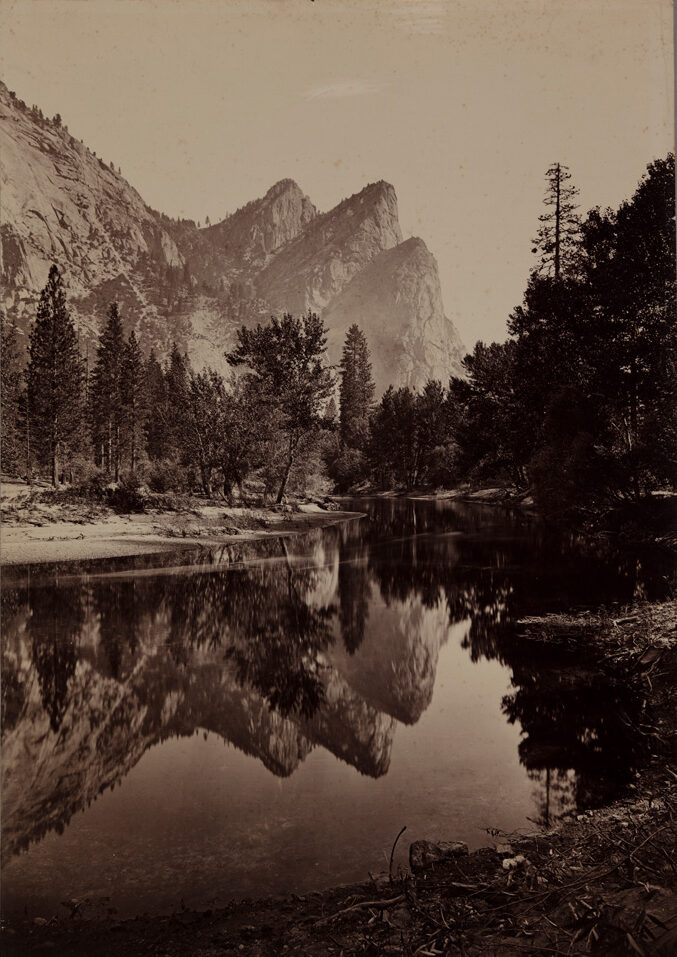
The Three Brothers, Yosemite, c. 1872
Albumen print
Watkins was a Naturalist whose detailed and awe inspiring representations of nature are generally regarded as the finest examples of 19th century American landscape photography. He was greatly admired by the Transcendentalist poets, such as Ralph Waldo Emerson and Henry David Thoreau, who had an abiding belief in the redemptive qualities of Nature. Emerson hung two photographs by Watkins in his home.
Naturalism was a broadly based belief in natural causes and processes, rather than supernatural or spiritual explanations of the world. This belief resulted in detailed and objective representations of the natural world, as seen in photographs by Watkins.
Beyond the inherent beauty of the subjects and his masterful rendering of nature, it is also impressive to consider the enormous difficulties involved in making his photographs, some of which were mammoth in size (18” x 22”). He traversed rocky trails with a wagon hauling his massive camera and glass plates. Then, he coated the plates with a light sensitive material in a dark tent and made the exposure within a few moments, all without getting dust on the plates. The exposure often took one hour and was usually done in the morning when there was little wind. Finally, the glass negatives were developed and varnished, all before making the hazardous return trip to San Francisco.
Oliver Wendell Holmes, the doctor, poet and cultural critic, admired Watkins’s work and collected it. Holmes wrote, “As specimens of art they are admirable, and some of the subjects are among the most interesting to be found in the whole realm of Nature…the three conical hill-tops of Yo Semite [The Three Brothers], taken not as they soar into the atmosphere, but as they are reflected into the calm waters below…shown clear, yet soft, vigorous in the foreground, delicately distinct in the distance, in perfection of art which compares with the finest European work.” – Tyler Green, Carleton Watkins: Making the West American
Spanish Label
Carleton E. Watkins, Estados Unidos, 1829-1916
The Three Brothers, Yosemite [Los tres hermanos, Yosemite], c. 1872
Impreso en albumen
Watkins era un naturalista cuyas representaciones detalladas y asombrosamente inspiradoras de la naturaleza son generalmente consideradas como los más bellos ejemplos de la fotografía paisajística estadounidense del sigo XIX. Fue enormemente admirado por los poetas trascendentalistas, como Ralph Waldo Emerson y Henry David Thoreau, quienes tenían un respeto inquebrantable en las cualidades redentoras de la Naturaleza. Emerson colgó dos fotografías de Watkins en su hogar.
El naturalismo era una creencia basada en grandes términos en las causas y procesos naturales, en lugar de explicaciones supernaturales o espirituales sobre el mundo. Esta creencia tuvo como resultado representaciones detalladas y objetivas del mundo natural, como se aprecia en las fotografías de Watkins.
Más allá de la belleza innata de los sujetos y su representación maestra de la naturaleza, también es impresionante considerar las enormes dificultades que conllevaban la creación de sus fotografías, algunas de las cuales era monumentales en tamaño (18” x 22”). Watkins atravesó senderos rocosos con un vagón transportando su enorme cámara y placas de vidrio. Luego, recubría las placas con un material sensible a la luz en una tienda oscura y realizaba la exposición en momentos, todo sin que cayera polvo en las placas. La exposición generalmente llevaba una hora y era usualmente realizada en la mañana cuando había muy poco viento. Finalmente, los negativos de vidrio eran desarrollados y barnizados, todo antes de emprender el peligroso viaje de vuelta a San Francisco.
Oliver Wendell Holmes, el doctor, poeta y crítico cultural, admiraba el trabajo de Watkins y lo coleccionaba. Holmes escribió, “…Como especímenes de arte son admirables y algunos de los temas están entre los más interesantes encontrados en todo ámbito de la naturaleza …las tres cimas cónicas de Yosemite [The Three Brothers/Los tres hermanos], tomadas no elevándose hacia la atmósfera, sino que reflejándose en las tranquilas aguas abajo… representadas claras, pero suaves, vigorosas en el primer plano, delicadamente inconfundibles en la distancia, en perfección con el arte que se compara con el arte europeo más fino”. – Tyler Green, Carleton Watkins: Making the West American [Carleton Watkins: La creación del oeste estadounidense]